BLUF: Title, basically.
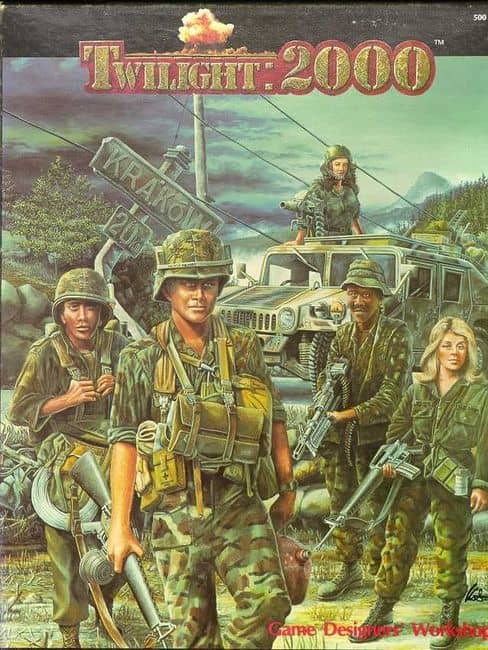
Extra Context: A couple years back, I picked up the 4th edition of Twilight: 2000. For those don’t know, this is a post-apocalyptic RPG which was first released during the absolute peak of Reagan-era Cold War saber rattling. Unlike other, more fanciful or escapist takes on life “after the end”, Twilight skewed much more simulationist, with Tom Clancy levels of hard-on for NATO and Soviet personnel and equipment statistics. Think This War of Mine meets ARMA 3, moreso than Fallout or Wasteland.
I start with this preamble to communicate how different in tone this system is from the games of 5e DnD I’ve played and run in the past. While the latest version of the Twilight rules is, to my understanding, significantly less packed with grognard crunch than previous iterations, I still find myself overwhelmed with all of the various mechanics and slight rule variations. As an example I hope is illustrative, to fire a weapon classified as a machine gun, your character uses their “heavy weapons” skill, but they follow the “ranged combat” rules, because heavy weapons typically refers to explosive type weapons. You also have to remember whether the MG you’re using is classified as Light, Medium, or Heavy, as there are different requirements/penalties based on your character’s stance. In and of itself, not too bad, and it pretty much tracks with the considerations I would put in place if I were designing this system, but it becomes a bit much with the everything else of the system. Case in point: the entry for hand grenades states: “grenades use the same rules as heavy weapons, with these exceptions:” and then goes on to list 6 bullet points, which makes me think that it hardly uses the same rules as heavy weapons at all lol.
To be clear, I don’t necessarily want to jettison this level of crunch, as I think it’s integral to the tone the system is designed around, but fuck me if it isn’t a lot to keep track of, especially since I’ll have to shepherd potential players through it efficiently if I have any hope of actually playing a game.
With that being said, any advice from the field? Experience with Twilight would be a bonus (any edition), but if anyone has general tips for tackling new systems, I’m all ears.
I don’t necessarily want to jettison this level of crunch, as I think it’s integral to the tone the system is designed around, but fuck me if it isn’t a lot to keep track of
Allow me to disagree with the highlighted statement. A mistake old school game designers used to make is to try and reflect every fluff detail in the rules. You don’t have to differentiate an assault rifle in full auto from an SMG and in most cases, even an HMG. If you go down this route, you will need to account environmental factors, fatigue, time of day… which are also big influencers. But we don’t, because that’s what randomizers are for. Just bundle the difference in the randomizers.
You’ll say, correctly, “getting hit by a .50 cal is a world of difference compared to a 9mm”. That’s true. That’s fiction and setting, though. It doesn’t have to be reflected in the rules of simulating shooting the things in a game.
My advice would be to do exactly what you proposed not to: chuck the entire system. Use a generic system instead. Whatever you’re most familiar with: Cortex, Savage Worlds, Fate, GURPS…
What is your story about? If it is about handling the gear, then perhaps (perhaps!) keep the OG system. If it’s about anything else - a shared overarching plot you’ll write with the players; about how the characters react and evolve to their surroundings; about interpersonal drama; base building, you name it - use a different system.
Of the ones I listed, Savage Worlds is easily reskinned, Fate is easily tweaked, Cortex is a toolbox to get your game moving fast just the way you want it to feel, and GURPS probably already has a module for you to use. If you want to bounce ideas with other people adapting to Fate and Cortex, they both have very active Discord communities (I know, information silo, but that’s where the authors hang out). Good luck!
P.S.: I just remembered Cepheus (a Traveller retrocolone) has the acclaimed Modern War from Zozer Games. I have played their Hostile (Alien universe RPG) and the ruleset is essentially the same. There is some crunch, but easier than D20: https://www.zozergames.com/modern-war.html
It looks like it and Delta Green lead sales on military RPGs: https://www.drivethrurpg.com/en/browse?genre=320-military
I personally disagree with the assertion that simulation is unnecessary because dice exist. Crunch and randomization work differently, and serve different purposes in a design. Crunch is good for accounting for the factors that are known, predictable, or obviously true in the fiction. Randomization, by contrast, is good for things not easily known or tracked, or that one could never guess would be true in the moment.
The point is not that crunchy simulation is undesirable, but that every simulation model is an exercise in where to draw the line in what accuracy you’re losing to keep your goals achievable. OP has expressed the crunch is too much for them. “It’s okay to draw the line further away from accuracy” was the core message I was trying to convey.
It gets easier with each new system. After a while it becomes “ok, so it’s approach to skills like in the other system and the armor rules from that other one”. What I do when assessing a new one is:
- how the basic mechanic works?
- we build the roll only from PC or also consider gear?
- how modifiers work? + to roll, step up dice, another dice, move TN?
- what are the odds of success, failure and “bigger success” on three edges of of skill - lowest, middle, top
- what does the bigger success mean mechanically?
- are there re-rolls/pushing the roll? Does it change the odds or is only a re-roll
- how leveling up works?
- what is needed to level up?
- how much does a level up change in the roll odds?
- how does money work?
abstract vs counting all the bills - is there anything exotic in the rest of the rules
things that are there to convey the feel of the setting- contacts working like money
- rules for gear getting used up
- running out of ammo
- meta currency
is it a hard earned boon or “the spice must flow”?
With crunchy systems I’d then forget about the more intricate half of the system, get the game on and try to have combats of varying size during first few sessions. Most of the time, if there’s crunch in the system, it’s mostly about combat.
Write on players’ sheets shortcuts what to roll on doing what. Like next to the gun name “shooting d6+d8”.
During first few games when you remember that there was some more crunch in the system but don’t remember exactly, don’t stop to look up. Ask a non-spotlighted player to search for it but “for now let’s roll this and that against that” and keep going.
Keep an eye out if they are getting into the crunch. If they won’t follow you down the rabbit hole in a few (3-5. not less) games, it might be that either you get the rules etched in your brain or that level of crunch is just not for this tableAnd on closing note, as far as I understand what T2k is, I would guess that getting their hands on an MG is not something common in the setting and the complexity of the rules for that are an outlier. I might be wrong, though
Your points about getting a baseline understanding of the flow and adding crunch in as GM and players get comfortable is well taken. My initial strategy was to focus on only one mechanic (in this case, firing a ranged weapon), but to know that mechanic absolutely front to back. However, in this system, firing a ranged weapon interacts with almost every mechanic in the game, so I was still trying to drink from the firehose. Thank you for taking the time and sharing your input.
in this system, firing a ranged weapon interacts with almost every mechanic in the game
Well. In that case, I would do the opposite. Have everything BUT combat in the first few games. So you build a foundation to then put the firing a weapon on top of it
- how the basic mechanic works?
If I wanna learn it, I usually have to be a player first.
The few times I’ve had to be the GM it always comes off the cuff. My most hated thing is pausing a game to look up mundane rules about encumbrance or climbing or anything.
Eventually you’ll learn, at most just write down what you should look up later.
The glass cannon recently did a campaign of it that’s going up on their YouTube channel currently
I always find it helpful to check some actual play to cement my understanding of certain rules. Although there’s no way to guarantee the actual play is definitely correct obviously
@calamitycastle @redhorsejacket Wait, which version of Twilight 2000?
They are playing 4th edition
Aye, I’ve been following their uploads and it has been helpful from a general observation perspective. I wish they were a little clearer about the rules they are navigating, but I recognize it’s not a teaching cast either. I will say it’s been illuminating how free-wheeling the Ref is with the NPC rules, which has helped me conceptualize the flow a bit better.
Right, a good lesson in and of itself I’d say. Sometimes you wanna modify shit to keep things moving
I don’t sweat to much with the details. Being a GM is hard as it is.
IIRC the gameplay loop from Twilight 2000 (and other Free League) is pretty simple and that’s the basis for everything else so remember this one and put the rest in your memory maybe it will come back, maybe not 🤷♀️ have fun
Could be I’m just dumb and unfamiliar with crunchier RPG systems, I’ll freely allow for that, but man, I feel like you and I have a different definition of “simple” lol. Considering this is a flowchart for adjudicating a single Ranged Combat roll, to say nothing of any other mechanic in the game. Granted, this is particularly egregious, but it’s also the main thing most characters will be doing in combat.
I suppose the old adage holds true. How do you get to Carnegie Hall? Practice, practice, practice.
Maybe it’s me that come from SR3 and think that anything not near that is simple 😅
IIRC most of the gameplay loop for T2K is roll Two Dice, count your successes, assess what they do.
I think that when played you mostly need that at least it was my experience in Mutant Year Zero
Is SR3, ShadowRun 3rd edition? I’ve never played, beyond the tutorial of the revival cRPG from years ago, but I recall being similarly aghast at the plethora of options in the character creator. It’s a shame, because the premise is awfully enticing. Ah well, as someone else in here mentioned, it seems like learning new systems has some inertia to it. The more you learn, the easier it is to learn more, since there only so many ways to roll a die lol. Maybe Shadowrun can be a project for future me.
There’s cool system to play Shadowrun out there.
Neon City Overdrive, Cities Without Numbers, SR2 is pretty good if you’re ok with inventing rules
-
Read the book
-
Create a bunch of 'test character"
-
Use these test character for a “test one shot” with player interested to try, and understanding that the point of the one shot is to learn to GM the system
Read the core rule book. Play a session. Evaluate if I liked it enough to continue playing it.
-