It wouldn’t be so bad if you couldn’t use the unrealized gains. But people can have a bunch of stock, get an untaxed loan, and have access to money without the tax burden. We should fix that.
You should have to pay on the yearly difference in value, and if that means you have to sell some to pay the tax then you should just get over it.
There’s a much better way.
Don’t tax the dollar value of the shares. Tax the shares themselves. Don’t demand the liquidation of the shares to pay the dollar value of the tax. Instead, just tax the shares themselves: confiscate the same percentage of the shares held, then have the IRS liquidate the confiscated shares slowly over time.
We can exempt $10 million from the portfolio of any natural person, then tax proportionately from every issue in that portfolio. No exemptions for artificial, corporate entities.
Basically, stocks, bonds, real estate, and other financial assets (the “ownership of the means of production”) should only be valuable to the working classes.
This is a wealth tax, not an income tax. We don’t currently have a wealth tax to decrease; we would be establishing a new one. I would propose 1% per year.
My investments
Are you a natural person? Is your portfolio less than $10,000,000 in value?
If you answered “yes” to both questions, nothing changes for you. This only applies to corporate entities and ultra-high-net-worth individuals.
The issue is you’re still incentivizing people to put money into higher returning investments rather than investing in more stable and assets, like bonds.
The only reason that higher returning investments are a problem is because they are used as a vehicle to drive wealth to the (ultra-)wealthy. When the wealthy are charged a high premium for these investments, that reason stops being a reason.
Unless you’re lowering the tax rate as I suggested, you’d have to add a lot of exceptions to not destroy most of the world’s established institutions
The established institutions in question are the ones creating the systemic problems. I see no compelling reason to maintain the institutions responsible. I see no compelling need for “a lot of exceptions”. Destroy them. To minimize disruption, we could phase it in over time. Perhaps starting with a $1 billion portfolio exemption and decreasing it to $10 million over the course of a decade.
This would have the ultra-wealthy converting their financial assets to tangible assets; they would be buying up personal property (produced by workers) hand over fist, while the working class would be buying up those liquidated shares from the IRS at a similar rate. Ownership interest in these companies would be rapidly conveyed away from the Problem Class to the Working Class.
This is a wealth tax, not an income tax. We don’t currently have a wealth tax to decrease; we would be establishing a new one. I would propose 1% per year.
We don’t need to call it something new. We already have property tax. It’s an average of 1.1% around the United States.
Real Estate property taxes are assessed at the county/parish level, and apply only to land and improvements on that land. Securities would not be considered “real property”. They are generally considered intangible personal property, which is not currently taxed. Further, the tax I am describing would be assessed at the federal level.
We certainly do need a way of distinguishing between existing real estate taxes and the proposed securities tax, even if the rates for the two taxes are identical.
Parent comment refers to “dramatically decreasing the tax rate”, but does not describe what tax rate they are decreasing. Parent comment crunches some numbers in which they assume a 3% tax rate, not a 1.1% tax rate comparable to real property taxes you describe.
They did not indicate what tax rate they meant when they said it would need to be decreased. They certainly aren’t referring to a real property tax rate when they suggest a decrease. I believe they were referring to either Federal Income Tax or Federal Capital Gains tax, which are approximately 25 to 50 times higher than the tax I was considering. Given the considerable discrepancy between what I meant and what they heard, I felt it important to indicate that this tax would be entirely separate from the existing taxes, and that it would be enacted for an entirely separate purpose.
I didn’t (initially) define a proposed securities tax rate, but I did provided context for calculating one:
"stocks, bonds, real estate, and other financial assets (the “ownership of the means of production”) should only be valuable to the working classes
I would tax those securities held by corporate interests and the obscenely rich at a rate equal to or greater than their expected return on investment, so that the benefits of securities ownership convey primarily to working class investors. From Parent Comment’s ROI (5%) and inflation (3%) numbers, the context I provided would allow for at most a 2% securities tax rate.
You’re advocating for maintaining status quo “institutions”. I’m advocating improvement. You’re advocating regression. I’m advocating progress.
Your criticism here makes your stance seem wildly inconsistent.
I think you need to explain what you mean by “institutions” when you suggest that I will be destroying them.
The “institutions” I believe will be destroyed by a securities tax are overtly harmful and should be destroyed. Can you provide me an example of a beneficial “institution” that would not survive?
No, I can’t “prove” to you that a “beneficial” institution would not survive
I don’t believe I asked you to prove it. I asked for examples of such institutions. When you say “institutions”, the first thing that springs to my mind are corporate landlords taking investor dollars to buy up residential properties, and artificially inflate housing prices. That is an example of an “institution” that is contributing to the problem. That institution exists primarily to benefit the interests of corporate entities and ultra-high net worth individuals. That is an institution that should not survive in its current form.
Either way, it’d miss the point that there are in fact institutions that do good in the world that are built on the current systems and need some means of transitioning or surviving your radical change.
Name some. You’re assuming I’m either going to destroy such institutions, or that I will need some sort of “exception” in order for them to continue operating. I don’t think this is likely. I think that such institutions would fall well within this plan. I think they could, for example, structure their portfolios to pass the security tax obligation through to the natural-person shareholders who own and control them.
For example, that abusive REIT I mentioned above is currently under the control of Problem Class shareholders. That problem class is using that control to transfer wealth from the working class to the problem class. When the Problem Class shareholders withdraw, this REIT comes under the control of Working-Class Shareholders; the kind of people who are harmed by that exploitative behavior.
Do you know how you make progress? You gain a deep understanding of how things work
Which is why I’m asking for examples. What harm do you think is going to arise from driving the Problem Class out of these nebulous “institutions”?
No, since you didn’t make any money and were not taxed. Also, the bond issuer is now in bankruptcy and/or being sued into bankruptcy. I might even get back the principle depending on the output of the legal proceedings.
Taxes are not injustice. And being unsympathetic to the risks that the owning class has to endure is not …“hatred”. More money, more problems, cry me a river.
Taking away savings that were already taxed is an injustice. The american revolution was triggered by less - merely taxation without representation. Imagine your 401k going down by 20% per year due to the annual wealth tax. Then when you pull out the money you pay income tax on that. Sound fair?
I’m not American and I’m 100% not interested in solving stupid problems caused by the contradictions rooted in the USA lacking a civilized welfare state. Tax your rich to fund a proper old age pension system. I don’t care about your stocks.
It depends on the details of the implementation. There are many possible solutions.
If we change it so the rule is like “if you use stock as collateral to get a loan, that is income and taxed as such” then no. You might just default on your loan, but that’s kind of on you and the bank for using a volatile asset as collateral.


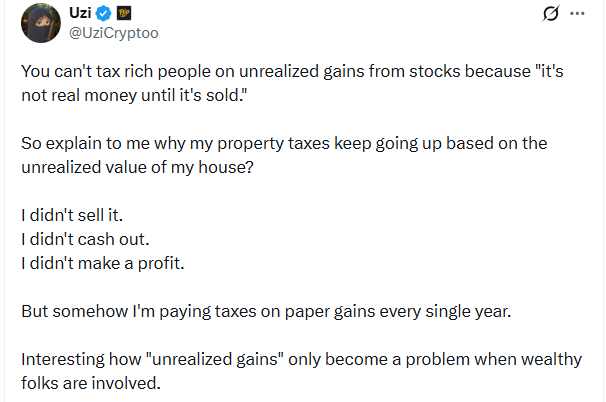
It wouldn’t be so bad if you couldn’t use the unrealized gains. But people can have a bunch of stock, get an untaxed loan, and have access to money without the tax burden. We should fix that.
Also property tax should probably be progressive
deleted by creator
There’s a much better way.
Don’t tax the dollar value of the shares. Tax the shares themselves. Don’t demand the liquidation of the shares to pay the dollar value of the tax. Instead, just tax the shares themselves: confiscate the same percentage of the shares held, then have the IRS liquidate the confiscated shares slowly over time.
We can exempt $10 million from the portfolio of any natural person, then tax proportionately from every issue in that portfolio. No exemptions for artificial, corporate entities.
Basically, stocks, bonds, real estate, and other financial assets (the “ownership of the means of production”) should only be valuable to the working classes.
deleted by creator
This is a wealth tax, not an income tax. We don’t currently have a wealth tax to decrease; we would be establishing a new one. I would propose 1% per year.
Are you a natural person? Is your portfolio less than $10,000,000 in value?
If you answered “yes” to both questions, nothing changes for you. This only applies to corporate entities and ultra-high-net-worth individuals.
The only reason that higher returning investments are a problem is because they are used as a vehicle to drive wealth to the (ultra-)wealthy. When the wealthy are charged a high premium for these investments, that reason stops being a reason.
The established institutions in question are the ones creating the systemic problems. I see no compelling reason to maintain the institutions responsible. I see no compelling need for “a lot of exceptions”. Destroy them. To minimize disruption, we could phase it in over time. Perhaps starting with a $1 billion portfolio exemption and decreasing it to $10 million over the course of a decade.
This would have the ultra-wealthy converting their financial assets to tangible assets; they would be buying up personal property (produced by workers) hand over fist, while the working class would be buying up those liquidated shares from the IRS at a similar rate. Ownership interest in these companies would be rapidly conveyed away from the Problem Class to the Working Class.
We don’t need to call it something new. We already have property tax. It’s an average of 1.1% around the United States.
Stocks are property.
Real Estate property taxes are assessed at the county/parish level, and apply only to land and improvements on that land. Securities would not be considered “real property”. They are generally considered intangible personal property, which is not currently taxed. Further, the tax I am describing would be assessed at the federal level.
We certainly do need a way of distinguishing between existing real estate taxes and the proposed securities tax, even if the rates for the two taxes are identical.
Parent comment refers to “dramatically decreasing the tax rate”, but does not describe what tax rate they are decreasing. Parent comment crunches some numbers in which they assume a 3% tax rate, not a 1.1% tax rate comparable to real property taxes you describe.
They did not indicate what tax rate they meant when they said it would need to be decreased. They certainly aren’t referring to a real property tax rate when they suggest a decrease. I believe they were referring to either Federal Income Tax or Federal Capital Gains tax, which are approximately 25 to 50 times higher than the tax I was considering. Given the considerable discrepancy between what I meant and what they heard, I felt it important to indicate that this tax would be entirely separate from the existing taxes, and that it would be enacted for an entirely separate purpose.
I didn’t (initially) define a proposed securities tax rate, but I did provided context for calculating one:
I would tax those securities held by corporate interests and the obscenely rich at a rate equal to or greater than their expected return on investment, so that the benefits of securities ownership convey primarily to working class investors. From Parent Comment’s ROI (5%) and inflation (3%) numbers, the context I provided would allow for at most a 2% securities tax rate.
The securities tax rate I had in mind was 1%.
I’m not interested in what billionaires would consider “real property”.
Stocks are property.
I see. How does that particular distinction affect this discussion?
deleted by creator
What?
You’re advocating for maintaining status quo “institutions”. I’m advocating improvement. You’re advocating regression. I’m advocating progress.
Your criticism here makes your stance seem wildly inconsistent.
I think you need to explain what you mean by “institutions” when you suggest that I will be destroying them.
The “institutions” I believe will be destroyed by a securities tax are overtly harmful and should be destroyed. Can you provide me an example of a beneficial “institution” that would not survive?
deleted by creator
I don’t believe I asked you to prove it. I asked for examples of such institutions. When you say “institutions”, the first thing that springs to my mind are corporate landlords taking investor dollars to buy up residential properties, and artificially inflate housing prices. That is an example of an “institution” that is contributing to the problem. That institution exists primarily to benefit the interests of corporate entities and ultra-high net worth individuals. That is an institution that should not survive in its current form.
Name some. You’re assuming I’m either going to destroy such institutions, or that I will need some sort of “exception” in order for them to continue operating. I don’t think this is likely. I think that such institutions would fall well within this plan. I think they could, for example, structure their portfolios to pass the security tax obligation through to the natural-person shareholders who own and control them.
For example, that abusive REIT I mentioned above is currently under the control of Problem Class shareholders. That problem class is using that control to transfer wealth from the working class to the problem class. When the Problem Class shareholders withdraw, this REIT comes under the control of Working-Class Shareholders; the kind of people who are harmed by that exploitative behavior.
Which is why I’m asking for examples. What harm do you think is going to arise from driving the Problem Class out of these nebulous “institutions”?
What happens when my socks value decreases 30% one month? Do I get a tax refund?
deleted by creator
No, since you didn’t make any money and were not taxed. Also, the bond issuer is now in bankruptcy and/or being sued into bankruptcy. I might even get back the principle depending on the output of the legal proceedings.
What happens to the property taxes you paid when your property value tanks? Do you get a tax refund then? No? Then no.
Ah, yes. It’s the old “one injustice makes a new one okay” argument. Hate much?
Taxes are not injustice. And being unsympathetic to the risks that the owning class has to endure is not …“hatred”. More money, more problems, cry me a river.
Taking away savings that were already taxed is an injustice. The american revolution was triggered by less - merely taxation without representation. Imagine your 401k going down by 20% per year due to the annual wealth tax. Then when you pull out the money you pay income tax on that. Sound fair?
I’m not American and I’m 100% not interested in solving stupid problems caused by the contradictions rooted in the USA lacking a civilized welfare state. Tax your rich to fund a proper old age pension system. I don’t care about your stocks.
Well, I can agree with you on that. Having lived in Europe briefly, I am aware of the stupidity over here.
It depends on the details of the implementation. There are many possible solutions.
If we change it so the rule is like “if you use stock as collateral to get a loan, that is income and taxed as such” then no. You might just default on your loan, but that’s kind of on you and the bank for using a volatile asset as collateral.
I appreciate that you took the question seriously and offered a useful response.
Got some bad socks there brother
Lol! Ya got me! Yeah, autocorrect is a bitch, and I failed to verify the text. Socks = stocks. (And it tried to change it to sticks that time).