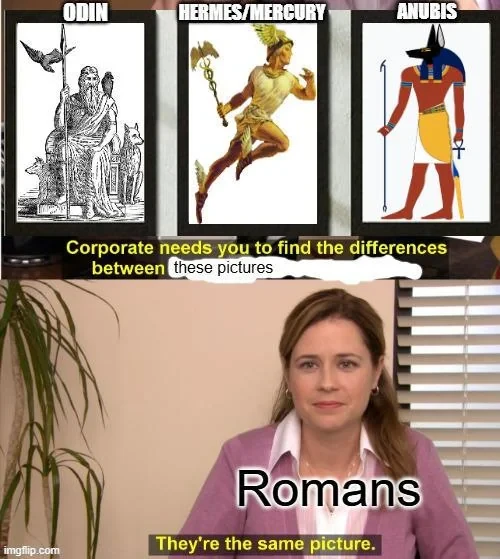

Explanation: Romans (and the Greeks they stole the practice from) viewed world religions through the lens of Interpretatio Romana. In this view, all the world worshipped the same gods, just by different names and with different ways of thinking about them. There’s a certain universality and pluralism to this logic: “Foreign folks aren’t so different from us, we’re all under the same heaven.” For that reason, Romans generally found it easy to engage with local religions and integrate with their faith, without insisting on anything resembling conversion. “You love Lenus, the god of war? We also love Mars, the god of war! Let’s make a sacrifice to the god of war, for security and victory.”
Sometimes this was intuitive - such as equating the Roman goddess of agriculture, Ceres, with the Greek goddess of agriculture, Demeter. Other times, it was a bit more of a stretch - Wodan, the grim one-eyed king of the gods in the Germanic pantheon, is equated with… Mercury, the swift god of trade. Why?
Because they both travel.
Hm.
Generally, this interpretatio was intuitive to local faiths as well. After all, the gods MY forefathers worshipped are MIGHTY. It’s only natural that even foreigners bow to the great Ra, even if they worship Him with a silly Latin name like ‘Sol’!
However, there were cases when this could cause tension rather than relieve it - notably with the Jews. While the Romans made some limited attempts to accommodate Jewish monotheists (such as exempting them from the duty to make sacrifice to the gods for the security of the Res Publica, instead accepting the word of the priesthood that they prayed to YHWH for the health of the Res Publica; and later, after the first Iudean rebellion, a tax instead of that), a mixture of Roman arrogance and a lack of understanding of the theology of Judaism caused repeated missteps and offense. Certainly, the Jews of the period were not particularly amused at the equation of YHWH with Jupiter, nor the Roman insistence on that bizarre and blasphemous notion!
So others’ aren’t so different but they are still all savage barbarians?
While we joke a lot about barbarians here, the Roman view of non-Roman cultures was more nuanced. A barbarian wasn’t necessarily some ‘savage’ who needed to be ‘civilized’ - in the view of the Romans, most societies had strengths and weaknesses, and the Romans were more than willing to acknowledge the strengths of other societies, even in excess of the Romans…
… in everything except the SUITABILITY to RULE over EARTH’S PEOPLE
The Romans often put no effort into assimilating or moving provincials of a ‘barbarian’ culture precisely because they didn’t mind if they continued their traditional ways, in most cases. Indeed, adherence to ancient ways, even non-Roman ways, could be very respectable - the Romans respected tradition even if it wasn’t their tradition (so long as it wasn’t offensive to their cultural norms). Aristocratic Romans often cultivated friendships across cultural lines precisely because they were capable of valuing foreign ways, even if it wasn’t an equal valuation to Roman ways.
To the Romans, Romans were, of course, better than barbarians on the balance - the Romans were the best possible balance of moderate and reasonable cultural traits, but that only meant that Romans should be proud (and they were annoyingly proud) and that Romans should rule - for the good of everyone, including the barbarians, of course!
But the barbarians also held many valuable traits and skills which the Romans freely admitted that Romans lacked. The rhetorician Fronto noted in a letter to the Emperor that Latin had no word for human warmth because Romans lacked that virtue entirely. As a rhetorician, this is obviously him engaging in hyperbole - but it does show that Romans did not regard their culture, even in the abstract, as perfect compared to others.
In this, a Roman could freely praise Gallic artisanship, Syrian academia, Egyptian theology, African cunning, Greek art, and Germanic bravery without ever challenging his own cultural chauvinism. Rome wanted to think of itself as team captain (or team centurion, complete with authority to beat subordinates) who marshalled every culture’s unique skills for a team victory (with them at the head, of course, also picking how the spoils of victory are divided), not the sole (cultural) inhabitant of the world.
Ah so similar to how the persian empire was perfectly fine with freedom of religion and self determination so long as they bent the knee to them and paid their taxes. I could see being a conquered people’s of the romans would be better than most other kingdoms as the status quo was to kill all the leaders and most of the men, rape the women, and outlaw the worship of the old gods.
as the status quo was to kill all the leaders and most of the men, rape the women, and outlaw the worship of the old gods.
Not quite - most peoples of antiquity were generally nonchalant about the gods of their subjects continuing to be worshipped, and certainly the Romans were not shy about killing leaders or abusing civilians during the conquest.
The big difference in this theology/pluralism comes in toleration vs. acceptance. The usual scenario for this period is the conquerors going “You have your gods, we have our’s. Clearly your’s are weak if they’re different from our’s, but you can keep them if you want.” - the Romans come in and essentially say, “I see you worship the gods too! Very good, very pious, we do the same thing!” It changes what is a fairly major cultural divide (different pantheons) into a nearly literally nominal difference (“You call the gods different names than we do? That’s quite alright, I’m sure the gods don’t mind”) that makes conqueror and conquered share in a common religious-cultural tradition. People are generally more amiable when they feel they have something in common with you, even something as abstract as religion.
Other culturally imperial powers of the period will build shrines to their own gods and exclude your gods - very annoying, especially since that’s YOUR tax money they’re spending. The Romans will build shrines and tell you that worshipping your gods at these shrines is a-okay, because it was always meant for those gods, and make sacrifices to your gods (“OUR gods”). That’s nearly a public service! Maybe these toga-wearing weirdos aren’t ALL bad?
The Achaemenid approach was slightly different - more of a “You have your gods, we have our’s, but we will guard your religious traditions and buildings from abuse just as we guard our own.” Which is also preferable to the “I’m going to use your taxes (or plunder your temples) to worship MY gods” approach-by-neglect by culturally imperial powers of the time without deeply ingrained notions of tolerance.
*note - the Romans plundered temples too, but it was okay, because they would use some of that plunder to build other, grander temples to the same gods. The gods basically won’t notice if their summer home gets a little ‘renovated’ and moved a few miles to the west, right?
*note - the Romans plundered temples too, but it was okay, because they would use some of that plunder to build other, grander temples to the same gods. The gods basically won’t notice if their summer home gets a little ‘renovated’ and moved a few miles to the west, right?
They did steal the entire inventory of the temple, including the god(s) that resided there. They even had a formal procedure for doing exactly that, evocation deorum. They basically called for the local gods to abandon the place about to be conquered and promised a better temple in Rome in return for that favour.
I love evocatio, I’d just like to note that it was a specific ritual, and that it isn’t always recorded as accompanying Roman looting of temples.
No need to perform an evocation on a god who isn’t powerful enough to interfere with your conquest, I guess…