I do have to agree with you. It’s a demand issue, combined with the rate that it is being built.
I think it would be fully okay to have the cost of a house be multiplicative, based off how many you own after the second house. So, if you are looking to buy a third house, the price is actually double than what you would be expecting, and then your fourth house would be triple what you’re expecting, etc.
The price of the house will be the cost the seller lists it as, and the seller gets the cost that they listed it as. However, anything over the cost it was listed, if you are affected by that multiplier, has that money go straight into the government.
The reason I say after the second house is because I do personally think it’s fair for someone to want a vacation home somewhere, I just don’t think it’s fair for someone to have an interest into having a second, third, fourth, or sometimes even fifth vacation home. And there are many cases where you would want to own a second property such as if you run a self-employed job such as a computer repair specialist, you will probably own a shop, and having a office that’s at twice the cost of what it normally would be is extremely cost prohibitive to someone wanting to get into the market.
I also firmly believe that there should be quite extortionate taxes for buildings that are labeled residential but have an owner who primarily rents it out for more than a quarter of the year. The whole Airbnb our property is technically zoned residential but are actually commercial loophole is absolutely ridiculous and a huge problem. If you aren’t allowed to put a motel or a hotel there, you shouldn’t be allowed to have an Airbnb there.
That’s trickier than it sounds.
The places where people buy third homes are the same places where NIMBYs can stop development of poor people housing. Even though those rich people need servants and servants need quarters.
If we’re already living in a world where we can tax homes at 100%, 200%, etc. then we’re also living in a world where we can pretty easily tell NIMBYs to go fuck themselves.
Catch 22. As a politician you gotta please the people with money. The people buying homes taxed 200% have the money. Until we reach Star Trek levels of selfless post scarcity society that’s not going to happen and by that point it won’t be necessary.
The problem with people who take your approach is you never actually use your negativity to offer solutions. Then you act like you’re “being realistic and just trying to help”, such that if someone calls you out you can try to deflect and feel smart. You aren’t contributing anything to the conversation but telling everyone things they already know.
Example of something even vaguely close to genuine participation in the conversation: “Hmmm, the NIMBYs won’t like that. We’d probably also want to include a rule that demands a certain amount of social housing per neighbourhood, or [other actual solutions]. We could also use town halls as ways to lure them(they love to complain in public) in and then explain exactly what market-rate housing is. There are answers for sure, maybe places like Vienna can show us how they got theirs in place.”
OH! And in the end, it would also be so awesome if you knew that in cities the “wealthy” neighbourhoods are actually net negatives for tax dollar input/output. The richer people aren’t actually contributing, they just believe they are because they have zero understanding of how density works.
It’s been my experience that saying out loud. The things that everyone says they know keeps everyone realistic and makes it so they can’t live in denial.
If you suggest a solution and the solution has a problem, the problem needs to be stated. Otherwise, people fixate on that solution and ignore the problem and things get worse instead of better.
If you want some solutions then I recommend a few.
Corporate ownership of residential units needs to be banned or strongly limited to the number of units they can own .
Square footage requirements need to be lowered.
People with enough property should be able to build rental units in the back.
Parking requirements need to be reduced in urban areas.
Mass transit needs to become a thing everywhere. I literally live in a city with no public transportation.
I would definitely tax secondary+ homes at a higher rate, but I don’t know how to solve the problem of rich people keeping poor people out other than mandating low-cost housing in those same exact neighborhoods. Which causes other problems like people deciding not to build at all. Which worsens the problem.
Some of that was subtext in my previous comments like the square footage thing.


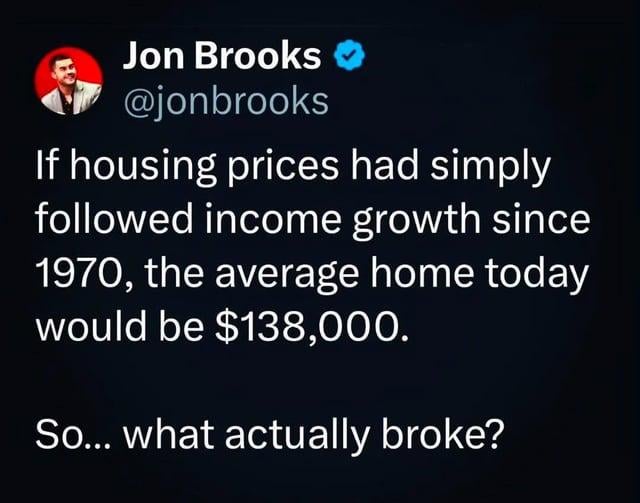
I do have to agree with you. It’s a demand issue, combined with the rate that it is being built.
I think it would be fully okay to have the cost of a house be multiplicative, based off how many you own after the second house. So, if you are looking to buy a third house, the price is actually double than what you would be expecting, and then your fourth house would be triple what you’re expecting, etc.
The price of the house will be the cost the seller lists it as, and the seller gets the cost that they listed it as. However, anything over the cost it was listed, if you are affected by that multiplier, has that money go straight into the government.
The reason I say after the second house is because I do personally think it’s fair for someone to want a vacation home somewhere, I just don’t think it’s fair for someone to have an interest into having a second, third, fourth, or sometimes even fifth vacation home. And there are many cases where you would want to own a second property such as if you run a self-employed job such as a computer repair specialist, you will probably own a shop, and having a office that’s at twice the cost of what it normally would be is extremely cost prohibitive to someone wanting to get into the market.
I also firmly believe that there should be quite extortionate taxes for buildings that are labeled residential but have an owner who primarily rents it out for more than a quarter of the year. The whole Airbnb our property is technically zoned residential but are actually commercial loophole is absolutely ridiculous and a huge problem. If you aren’t allowed to put a motel or a hotel there, you shouldn’t be allowed to have an Airbnb there.
And all that extra money goes to building social housing.
That’s trickier than it sounds. The places where people buy third homes are the same places where NIMBYs can stop development of poor people housing. Even though those rich people need servants and servants need quarters.
If we’re already living in a world where we can tax homes at 100%, 200%, etc. then we’re also living in a world where we can pretty easily tell NIMBYs to go fuck themselves.
Catch 22. As a politician you gotta please the people with money. The people buying homes taxed 200% have the money. Until we reach Star Trek levels of selfless post scarcity society that’s not going to happen and by that point it won’t be necessary.
I like how we’re making a scenario where things might actually go well and you’re still trying to find ways to lose.
I’m trying to find realistic solutions. And if we don’t red team premortem then we are building to fail.
The problem with people who take your approach is you never actually use your negativity to offer solutions. Then you act like you’re “being realistic and just trying to help”, such that if someone calls you out you can try to deflect and feel smart. You aren’t contributing anything to the conversation but telling everyone things they already know.
Example of something even vaguely close to genuine participation in the conversation: “Hmmm, the NIMBYs won’t like that. We’d probably also want to include a rule that demands a certain amount of social housing per neighbourhood, or [other actual solutions]. We could also use town halls as ways to lure them(they love to complain in public) in and then explain exactly what market-rate housing is. There are answers for sure, maybe places like Vienna can show us how they got theirs in place.”
OH! And in the end, it would also be so awesome if you knew that in cities the “wealthy” neighbourhoods are actually net negatives for tax dollar input/output. The richer people aren’t actually contributing, they just believe they are because they have zero understanding of how density works.
It’s been my experience that saying out loud. The things that everyone says they know keeps everyone realistic and makes it so they can’t live in denial.
If you suggest a solution and the solution has a problem, the problem needs to be stated. Otherwise, people fixate on that solution and ignore the problem and things get worse instead of better.
If you want some solutions then I recommend a few. Corporate ownership of residential units needs to be banned or strongly limited to the number of units they can own . Square footage requirements need to be lowered. People with enough property should be able to build rental units in the back.
Parking requirements need to be reduced in urban areas.
Mass transit needs to become a thing everywhere. I literally live in a city with no public transportation.
I would definitely tax secondary+ homes at a higher rate, but I don’t know how to solve the problem of rich people keeping poor people out other than mandating low-cost housing in those same exact neighborhoods. Which causes other problems like people deciding not to build at all. Which worsens the problem.
Some of that was subtext in my previous comments like the square footage thing.