• 25 Posts
  • 217 Comments
Joined 11 months ago
cake
Cake day: June 14th, 2025

help-circle
  • The “largest rocket” also peaked in the 1970s and is now getting smaller. . Rocket fuel is basically made of kerosene.

    Fun fact. Notice that on rockets designed to get farther out into space that the actual capsule is tiny and the rocket is essentially an enormous fuel tank needed to carry all the fuel you need to carry all the fuel you need?

    So the fun fact is that if planet earth was 1.5 diameters larger, gravity would be stronger. If gravity was just that much stronger, humanity would still be unable to get to space. Right now, we discovered oil, which had just barely enough energy per mass to allow a launch to orbit. But if gravity was a little more, we would not have any technology that could do it. This tells a story about the limits of human ingenuity. We were just lucky to discover the resources ready to go, we did not invent the resources.


  • If shit properly hits the fan, I suspect things are going to be way more desperate.

    To be a little more precise, people have studied this question carefully at a planetary scale.

    The total agricultural production possible in the absense of artificial inputs like fertilizers, pesticides, diesel tractors, cold storage and refrigerated supply chains etc is around no more than 3billion people running off solar inputs and natures nutrient cycles and the amount of land and water available.

    Pretty shocking number if you don’t have the context, but here is a place to get started on the information this is based on.

    So for example, in the green revolution, land and agriculture technology increased a modest amount, but artificial fossil inputs into the existing technology system increased 90-fold. Most of the gains in food production are because it’s now based on fossil energy and nutrients rather than natural sources.

    Currently, today ~40% of all the human food supply molecules come from fossil fuels and are incorporated into the plants and animals we eat.

    So it’s not “just” a land management issue, or urbanization. Humanity is literally on artificial life support. There is no simple, survivable way out of this commitment. Fundamentally this is far, far from penciling out any other way we know how to survive. Humanity population passed some threshold for change around 3-4 generations ago.


  • https://lemmy.zip/c/collapse

    In the collapse community people have been aware of a “thermodynamic” collapse of energy supplies for quite a while.

    So for example, to mainstream people and the investors, there is something called ‘oil’ which seems like a commodity item.

    In the collapse community, worldwide supplies of diesel and heavy oil energy products (shipping, trucking, agriculture, mining and gasoline refining among many other applications) has been in a 10-year long period of decline with major implications for our global civilization.

    (Diesel / heavy crude comes from several places globally. The USA has run out but Venezuela and Iran are two heavy hitters for the molecules needed.)

    The blockade on the strait is only having any impact because it’s a zero sum game now that nobody can raise production any higher. Like you don’t see Norway and Canada suddenly ramping up and filling demand, right?

    I consider this the most parsimonious and cogent world view.

    In a short summary: the blockade is an artificial shortage that is designed to collapse and bankrupt the most dependent and vulnerable nations in the global periphery, which is a “triage” that preserves oil supplies for the wealthy nations in the long run. Like this triggers collapse, and then as a second order effect global demand will fall for energy which is in an irreversible depletion event. This is the only way the most developed nations extend their existence through the crash.

    This is all an open secret, you can dig into technical papers and agency reports and academic publications, everything will say the same thing. However, this is not really a “mainstream” consciousness.


  • This guy writes in a lot of jargon, but basically what he is saying is that as the economy braces for impact, its pretty obvious that if any of the companies trading stocks are going to survive in a hyperinflationary spiral, their future stock price will be able to go a lot higher. So people are basically trading up the prices to anticipate this as the economy collapses and “prices” for stocks are hitting all time highs.

    Paradoxically, this does not measure GROWTH of the economy.

    The thing being measured is company share price DENOMINATED in dollars which are falling in value / hyperinflating because of DEGROWTH in the real resource flows.


  • Sure.

    Whichever convention you measure it is fine, but I think you’d have to do the same system on both wheels. Stroke, wheel path or vertical travel, just pick any one system and use it consistently.

    Currently what’s going on is that each wheel is measured from different systems.

    The RESULT is that FOR NO REASON bikes are specced with significantly less REAL travel on the front wheel than the rear wheel. You can absolutely feel this just riding. My issue isn’t with which number we use, it’s the actual bike spec is crazy.

    Like, ignoring the numbers/naming, the actual motion isn’t close to correctly matched.

    The ONLY thing that matches are the reference numbers from two dissimilar naming systems, which is where the insight comes from that the product development is very, very poor. Who is actually thinking? Who tests this gear?

    (I think somehow they decided they can get away with this through marketing. Presumably a LOT of customers are over-biking and don’t even notice or ride at a level where this is relevant.)

    You might think this is splitting hairs? So why then does a mid travel bike have 150/130 or 140/125?

    An enduro bike has 160/160? A downhill bike has 200/200? These bikes are even more slack! Come on, this is just so stupid. There is literally no reason not to just run a longer fork.

    Well… Ok, there is a reason, but it is embarrassing for consumers.


  • Step one: billions of dollars are invested on oil refineries that have a specific target range for their input

    Step two: oil coming out of the ground isn’t what the refineries need, so they blend different grades of crude oil to operate.

    Step three: by 2025, the costs of the heavy crude are skyrocketing. So government prints money to subsidize the costs to hide this from the market.

    Step four: even with subsidues its too expensive again, so the government begins giving refiners heavy crude straight from the strategic reserves

    Step five: the system breaks when there are simply not enough heavy crude molecules to keep it going.

    Step 6: this hidden stress is not noticed by the public + media. So the government provokes a conflict with Iran. Iran responds and the underlying problem becomes obvious. Iran and Trump take the blame as if this is a human-led shortage.

    Step 6a: the price of refined oil products is too high for the previous global order to pay, economic collapse is inevitable for the global picture

    Step 7: the world is forced into an physical oil triage response which hits the global periphery hardest and preserves heavy crude for the richer nations


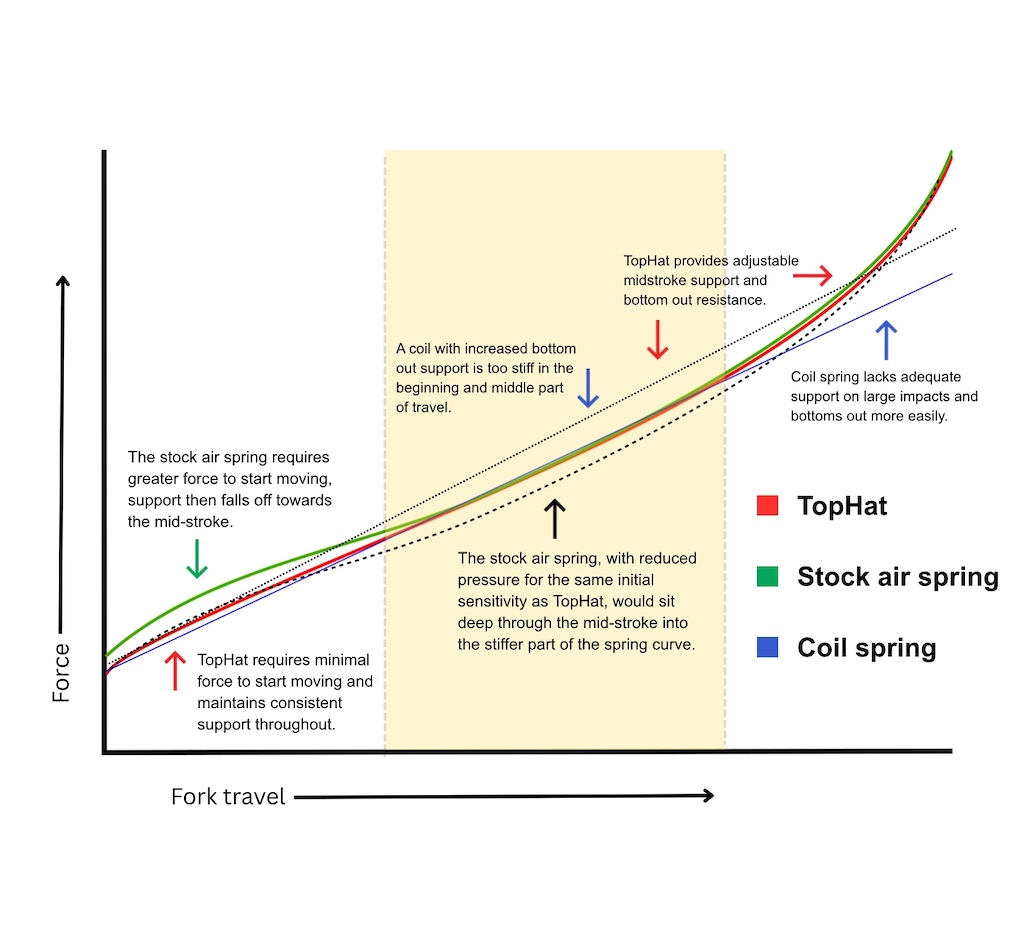
  • Take a close look at this graph here.

    As you can clearly see, the main effect of this modification is in the curve of the initial part of the fork travel.

    Cool, huh?

    Now, consider where your fork would be in the travel once dynamically sagged during a ride (usually around 20-25% of travel is gone when you just weight the bike, actually positive motion ride characteristics are only the last 2/3 of stroke.)

    It appears that this actually doesn’t truly do anything at all. The fork performs the same unless you unweight the fork and move it negatively below sag position. All the subjective ride impressions are just placebo effect.


  • This schism between the two brains is basically equivalent to the two kinds of knowledge: instrumental versus relational.

    In instrumental knowledge you have a fixed plan with a starting point, directions and an end point, but you often don’t know why it works or how it fits into any context.

    With relational knowledge you have an overall concept and can make any number of plans but some of them might not work out or may not be optimal.


  • That’s exactly what he is saying. Renewables deliver power to the grid.

    What he is saying is that at the same time they provide power, they don’t deliver energy (if you do all the accounting for the system).

    This doesn’t laud fossil fuels. This is only a critique on renewables if fossil fuel use is a negative. He is saying that renewables (right now) are a scam for being not enough of real solution to the problem of fossil fuels.

    Do not mistake being qualified on using renewables as pro-fossil fuels. The author is actually saying renewables aren’t automatically anti-fossil fuels and we are doing them wrong. He’s calling for a clear minded adult conversation and not childish oversimplifications. As far as I can tell, he’s saying this can’t work if we don’t get rid of “grid” systems entirely. We need a totally different system.

    The problem is that people are fooling themselves about what is going on, really.


  • Drawing some arbitrary line between energy sources and ‘power amplifiers’ is a distinction without a practical difference.

    So if you were talking about a car, there is no difference between the volume of the fuel tank and the horsepower of the engine? ;)

    The whole point of this article is that people are totally muddled up about the distinction. The title starts 'power, not energy… '.

    With all due respect, his point is made clear by your comment.

    Also, the word he uses is ‘exergy’. You said ‘Energy’. I’m not clear you followed the logic.