
You must log in or # to comment.
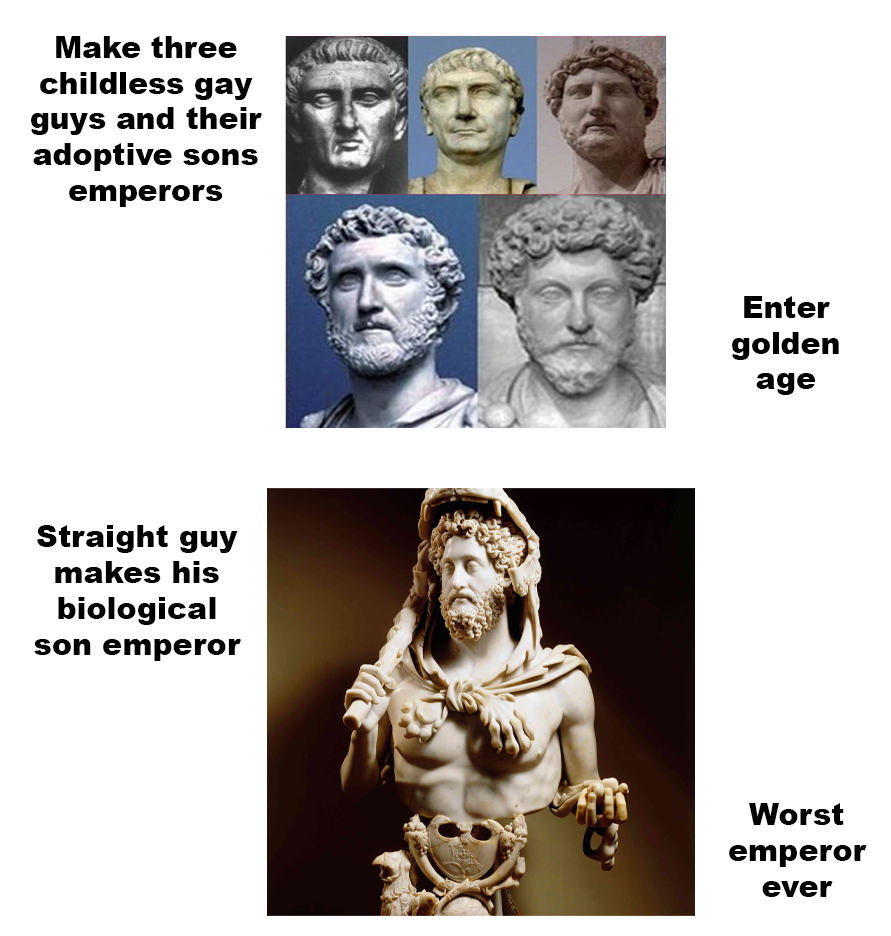
Explanation: Depicted up top as the three childless gay guys are Nerva, Trajan, and Hadrian.
Nerva was a temperate and even-keeled man elected by the Senate after Domitian was overthrown, and was a lifelong bachelor with rumors that he had love affairs with men (male affairs were not all that exceptional for Roman men, just something that was noted by the notoriously gossipy Roman histories). He adopted Trajan, who was an adult already and a popular military man.
Trajan was married and had a cordial relationship with his wife, but was quite openly and famously attracted to men. He was, as mentioned, a military man, and one who brought the Roman Empire to its greatest extent, but was noted for having a spirit of cooperation, civility, and due process rather than the dictatorial military mien one might expect from a career soldier. For this reason, the Senate adored him and called him ‘Optimus Princeps’ - ‘The Best Emperor’, a title later historians would keep for him.
Hadrian, Trajan’s adopted son, was also militaristic and quite openly gay. Unlike Trajan, Hadrian had a bit of a temper and a contentious relationship with the Senate - and his wife! Hadrian, however, was also a cultured and dutiful Emperor who attempted extensive legal reforms to establish the rule of law over the pre-eminence of the Emperor. Mostly it didn’t outlast him, but it was a nice thought! He, quite famously, deified his (male) lover Antinous, and Antinous would remain a symbol of male-male sexual attraction for the next ~1800 years.
Hadrian adopted Antoninus Pius, who was straight - in fact, Pius is one of a very small number of Roman Emperors we have no rumors of same-sex activity about. He was noted for his mildness, his justice, and love of peace.
Pius adopted Marcus Aurelius and Lucius Verus - Lucius Verus died fairly young in his Emperorship.
Marcus Aurelius had a biological son, Commodus, who was… not a good Emperor. At all.
And they all aspired to outdo someone from their past …

Some guy: “Empires are gay.”
Romans: “THEN I’LL FUCK A HUNDRED THOUSAND MEN. I WOULD DO ANYTHING FOR ROME.”
Trajan, like many Romans, was a big Alexander the Great fan. One of my favorite stories illustrating his… tastes… is when a certain king on the eastern frontier, I believe, screwed over one of Trajan’s plans by not fulfilling his treaty obligations, probably to provide troops or provisions or something. Trajan was fit to blow, and the king in question realized that he was screwed if Trajan’s fury came down on his head. So he sent his son, who was famously handsome, to apologize to Trajan, which Trajan apparently immediately took well - on account of it coming from a pretty young man. The prince then, after a diplomatic feast, danced for Trajan ‘in the barbarian manner’, and Trajan let the kingdom off the hook entirely.
Must have been one hell of a lap dance
Might have something to do with grown men wanting to surround themselves with hundreds, even thousands of young virile men in their sexual prime in excellent shape and full of energy and lust. If you bring together a bunch of men in their sexual prime into a group with no sexual outlet for the opposite sex … what do you think is going to happen? … Whatever is going to happen, it’s going to involve a lot of moanin’, groanin’, pumpin’ and sweatin’.
tbf, Roman soldiers formed relationships with local women, and relatives of other soldiers interestingly enough, with great regularity, to the point where many towns trace their origin to the surrounds of Roman fortress and camp positions. It’s doubtful that anywhere they went there was a shortage of women, except on the most brutal and focused of campaign marches - especially if you account for camp followers.
One of the issues is that a republican-era law, possibly never formally repealed, forbade Roman soldiers specifically from being willingly penetrated (as that would demonstrate, as representatives of the republic, the republic itself being metaphorically violated), which would cause roughly half of all soldier-soldier liaisons to be in an… unfortunate position.
You’ve actually re-ignited some questions I’ve had for a while about the details of gay sex in the Roman military, I’m gonna do some extra reading on the subject.
lmao, when I call my (conservative, Christian) mom this week and she asks what I’m reading, I’m gonna have to answer with a vague “Oh, just some books on Roman history”, when in detail it’s:
-
Ancient Rome and the Construction of Modern Homosexual Identities
-
The Marriage of Roman Soldiers (13 B.C. - A.D. 235): Law and Family in the Imperial Army
-
Homosexuality and Civilization
-
Un-Roman Sex; Gender, Sexuality, and Lovemaking in the Roman Provinces and Frontiers
-
Roman Homosexuality: Ideologies of Masculinity in Classical Antiquity
THIS IS ACADEMIC STUDY OF SAY GEX, YOU WOULDN’T UNDERSTAND, MOM
You’ve actually re-ignited some questions I’ve had for a while about the details of gay sex in the Roman military, I’m gonna do some extra reading on the subject.
I’m happy I’ve reignited that passion … for gay sex … eh, for Roman gay sex … um, for Roman gay sex performed by others … ahhh, for Roman gay sex performed by others in the past … ummm, for Roman gay sex performed by others in the ANCIENT past!
Roman bed death would be such a terrible fate 😭
Damn. I finished the chapter relating to homosexuality in The Marriage Of Roman Soldiers, and it didn’t answer my core questions.
I know way more about ancient Roman sexual practices than anyone who isn’t a specialist (or at least titillated by such subjects) should, but I’m still in the dark about Roman frotting, handjobs, and intercrural sex! Romans regarded penetration as shameful - so I’m wondering if soldiers who rubbed or ‘gave a comrade a hand’ were permissible. Was that ‘just being a good friend’, or was it regarded as some metaphorical form of penetration? I know Greeks participated in frotting and intercrural sex, so it’s not like such practices would have been unknown to Romans.
Hopefully, one of the other four books is more fruitful.
That being said, there was a passage mentioned of interest to this conversation - during the reign of the Emperor Domitian (may his name be forever cursed), a tribune and a centurion both admitted to being ‘passive’ homosexuals (as a means of asserting that they were not part of a conspiracy, because being ‘passive’ homosexuals meant that they did not command the necessary social sway amongst their fellow soldiers to play such politics), and were not punished for it.
That seems to my reading, to fairly definitely suggest that the mid-Republic punishment for passive homosexuality in the Roman military (suggested by the Greek writer Polybius, contemporary with the mid-late Republic, who was enamored with Rome but not always 100% accurate on the details) did not last into the Principate, if indeed it was accurately reported by Polybius. No way you get high-ranking officers like that up and publicly confessing to being passive homosexuals without punishment if it’s still a crime against military discipline - especially with one as a member of the brass (the tribune would have been a member of the two highest classes of Roman society) and the other as an enlisted man (the centurion would have been a man of prestige and authority, but ultimately a common soldier - one of the miles caligati ).
deleted by creator
-
I first learned about Commodus when as a kid, it was because I asked my grandmother why she always referred to a toilet as “the commode” and got an explanation about Commodus being an extremely unpopular ruler. Now, I’ve since been told that this isn’t where that term comes from at all and that the reference to the Roman emperor is just a popular misconception, but still, you have to fuck up real bad I’d think for people in a country on an entirely different side of the world the better part of a thousand years later to still think that it would be fitting for your name to be literally shat on.
His name is synonym with laziness, inaction, and comfort, in Portuguese.

You don’t understand. I knew them all personally, they were just roommates.